
Most people do not think about their plumbing until something goes wrong with it, and winter has a way of making that happen at the worst possible moment. A little bit of preparation before the rain and cold really settle in can save a homeowner from a call that starts with water pooling somewhere it should not be. This is really just a set of plumbing tips before winter, nothing complicated, but the kind of thing that gets skipped year after year until it does not.
California winters are not the same everywhere, and that matters more than people assume. Coastal and inland Southern California see a concentrated rainy season, usually December through March, that puts real stress on storm drains and aging sewer lines after months of dry weather. The Bay Area, with a lot of older housing stock still running original cast iron or clay sewer laterals, tends to see root intrusion and backups pick up right around this time too. Meanwhile, in the high desert and mountain adjacent communities, the bigger worry is not rain at all. It is overnight freezes, and exposed piping that was never built to handle that kind of cold snap.
So the checklist below is not one size fits all, and honestly, not every one of these plumbing tips before winter will apply to every household. Some of it matters more depending on where in the state you live, and that is fine. Go through it and skip what does not apply.
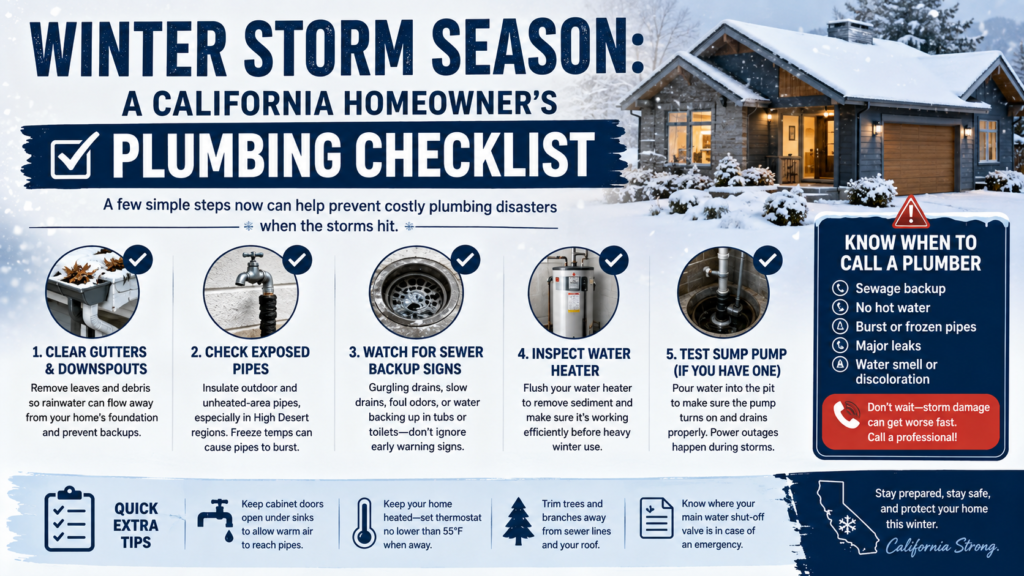
Clear Gutters and Downspouts Before the Rain Starts
This sounds almost too simple to matter, but clogged gutters are one of the more common causes of water finding its way somewhere it should not be during a storm. Leaves and debris build up over the fall, and when heavy rain hits, water backs up and can run down toward the foundation instead of away from it.
Walking the perimeter of the house and clearing anything blocking the downspouts takes maybe twenty minutes. Downspouts should also be directed at least a few feet away from the foundation, not just dumping water right next to it. It is one of those tasks that feels unnecessary right up until the first big storm proves otherwise.
Check Exposed Pipes, Especially If You Are in a Colder Area
If you live somewhere like the high desert, or one of the mountain adjacent communities that sees actual overnight freezes, this part matters more than it might in, say, a coastal city that rarely dips near freezing.
Exposed piping, hose bibs, and anything running along an exterior wall or through an unheated garage is at risk when temperatures drop suddenly. A cheap foam pipe sleeve or even wrapping in old towels can be enough to get through a cold snap without a cracked pipe. Disconnecting garden hoses and shutting off exterior water lines, if your home has that option, is worth doing before the first hard freeze rather than after.
This is genuinely one of the more preventable causes of an emergency plumbing call in winter, and it is also one of the cheapest to prevent. A burst pipe from freezing can mean real water damage inside a wall, and that is a far more expensive fix than a few dollars of pipe insulation would have been. If the goal is simply to prevent pipe burst California cold snaps sometimes cause, insulating exposed lines is the single most cost effective step on this whole list.
Know the Early Signs of a Sewer Lateral Backup
This one applies more to homes with older infrastructure, which describes a fair number of neighborhoods across the state, particularly in established areas of the Bay Area and parts of the greater Sacramento region where clay pipe is still common.
Slow drains throughout the house, not just one sink, is often the first sign. Gurgling sounds coming from drains when a different fixture is used, like the toilet gurgling when the washing machine drains, is another one worth paying attention to. Occasional sewage odor near a floor drain or in the yard, especially after heavy rain, can point to a lateral line that is struggling to keep up, sometimes from root intrusion, sometimes from age related cracking.
None of these signs mean disaster is imminent. Often it is a smaller issue that gets worse if ignored through an entire rainy season. Catching it early is really the whole point.
When It Is Time to Call an Emergency Plumber
Not every plumbing issue during winter needs an emergency call, and honestly, most do not. But a few situations are worth acting on quickly rather than waiting to see if it resolves on its own.
Active water intrusion inside the home, a pipe that has clearly burst, or a complete loss of water pressure are all reasonable reasons to call right away. So is sewage backing up into a tub or floor drain, since that tends to get worse quickly and can affect more than one part of the house. If a water heater stops working entirely during a cold stretch, that is inconvenient rather than a true emergency in most cases, though it can feel urgent enough at the time.
The general rule of thumb, and it is a fairly reasonable one, is that anything actively causing water damage right now is worth an emergency call. Anything that is a slow, developing problem, like a sluggish drain, can usually wait for a regular appointment, though it should not be ignored indefinitely either.
A Little Prevention Goes a Long Way
Winter plumbing problems in California are rarely dramatic on their own. It is usually a small thing, a clogged gutter, an exposed pipe, a sewer line already under strain, that turns into something bigger because nobody looked at it beforehand. Working through a short checklist once a year, right before the season turns, is a fairly small effort for the amount of trouble it can help avoid.
For homeowners trying to prevent pipe burst California winters can sometimes cause, especially in the colder inland and high desert areas, taking these steps early is worth the modest effort involved.
If something does go wrong, or you are simply not sure whether what you are seeing is a bigger problem, MR.PlumberCalifornia connects homeowners across the state with independent local plumbing providers who can take a closer look. Coverage includes areas prone to winter storm issues like Sacramento and Oakland, as well as high desert communities like Apple Valley where freeze related pipe bursts are more of a concern. The full list of areas covered is available on the Locations page.
Getting connected does not require an account or a lengthy form. A short call is usually enough to check coverage for your area and get matched with an independent provider who can help before a small issue turns into a bigger one this winter.